"God, restore truth to the world! It will be more than a peace treaty; it will be more valuable than any alliance. No one, no nation, no state can be secure if human relationships can be corrupted at any time by the tools of lies. There will be no security, no treaties, nothing that is valid and safe, if the consciousness of any nation is distorted by deliberate lies. Every lie conceals a plot and violence; every lie is an attack on the safety of the world." – Karel Čapek, September 1938
One of the most significant Czech writers of the interwar period, a successful journalist, playwright, and translator from French, an enthusiastic gardener, an amateur photographer, and a traveler – all of this was Karel Čapek, a masterful storyteller, but also a keen observer of human nature. According to his friend, the journalist Ferdinand Peroutka, he "elevated Czech literature to the level of world literature." He secured his immortality primarily through novels and plays that warn against the abuse of political power or technology, which remain relevant today and are published worldwide.
Karel Antonín Čapek was born 135 years ago, on January 9, 1890, in Malé Svatoňovice, near Trutnov, to the family of a rural doctor, Antonín Čapek, and his wife, Božena, née Novotná, the daughter of a mill owner from Hronov, as their third child. He had an older sister, Helena, four years his senior, and an older brother, Josef, three years his senior. He spent his childhood in Úpice, where the family moved shortly after his birth. His father worked as a company doctor in the local textile mill in Úpice, where he founded a folklore museum and became a member of the town council.
After completing elementary school in Úpice in 1901, Karel was accepted into the eight-year gymnasium (secondary school) in Hradec Králové. His determined mother refused to let the eleven-year-old boy go alone, so his widowed grandmother, Helena Novotná, from Hronov, lived with him in a rented apartment in Hradec and provided his grandson – a top student – with every comfort. However, he was expelled from the school for participating in the activities of an anti-Austrian student organization, so in September 1905, he transferred to the gymnasium in Brno, where his sister Helena had recently moved.
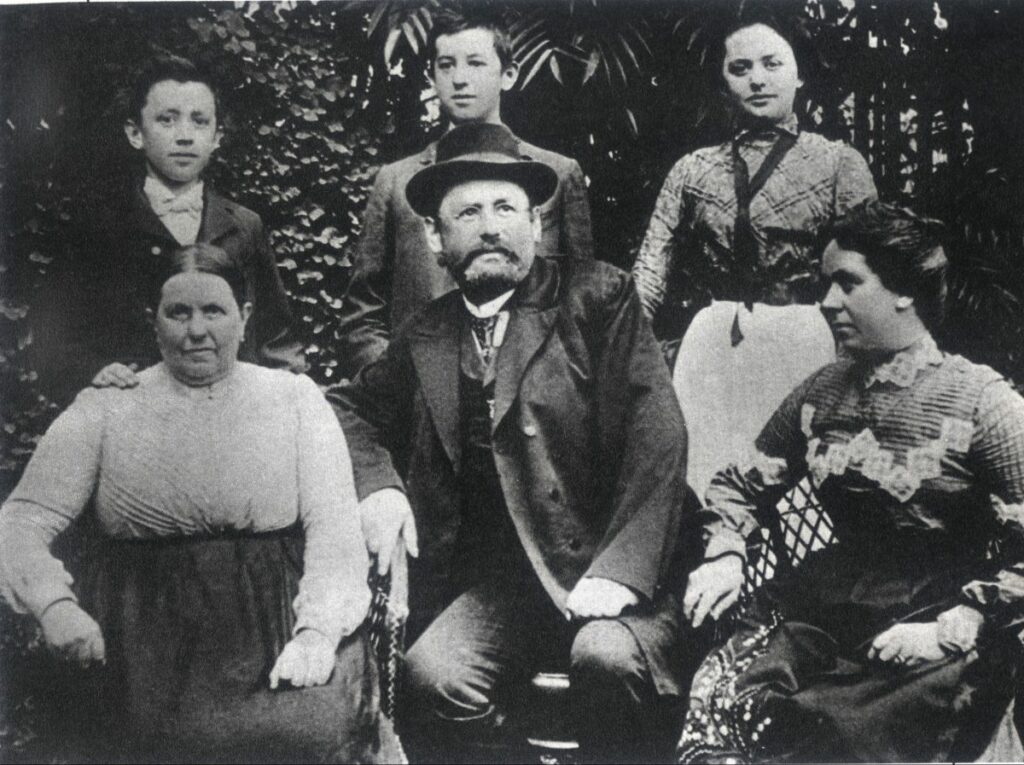
The family of MUDr. Antonín Čapek: standing, the children Karel, Josef, and Helena; seated, grandmother Novotná and his mother, Božena. Photo: Municipal Library of Žernov
When he was seventeen, his parents sold the house in Úpice, and the family, along with his grandmother, moved to Prague's Malá Strana (Lesser Town). In 1909, he graduated from the Academic Gymnasium in Prague and then studied aesthetics and philosophy at Charles University, earning a doctorate in philosophy in 1915. From 1910 to 1911, he studied at the University of Berlin and the Sorbonne in Paris.
From the age of 21, he suffered from Bechterew's disease, a chronic inflammatory disease of the vertebrae, which is why he was not conscripted into the Austrian army and did not have to fight in World War I, although the horrors of the war affected him deeply.
After graduating, he initially translated works by prominent French poets such as Victor Hugo, Charles Baudelaire, and Paul Verlaine, and briefly worked as a private tutor for Count Lažanský at Chyše Castle in the Karlovarsko region. In the fall of 1917, he returned to Prague and began a career in journalism. Together with his brother Josef, he became an editor at several newspapers and magazines – Národní Listy (1917–1921), the weekly Nebojsa (1918–1920), and Lidové Noviny (from 1921).
He was a masterful storyteller and wordsmith, capable of blending journalistic and artistic styles, using both formal and colloquial language, or even slang. In his articles and essays, he often experimented with language and created new literary forms. His short, often humorous articles, which commented on current social or political events, became very popular, and readers loved them for their wit and depth. Later, they were published in book form (The Gardener's Year, How Things Are Done, On General Matters, or Zoön Politikon).
Karel Čapek was also an avid traveler. He primarily traveled by train, but in the last three years of his life, he switched to driving, although he didn't get a driver's license due to his emotional nature. He owned a Škoda Popular car, which was driven by his wife, Olga Scheinpflugová. He didn't prepare for his trips, didn't use any guidebooks, and left things to chance. Thanks to his knowledge of languages, he didn't have any problems. As a result of his travels through Europe, he wrote articles filled with vivid descriptions and personal observations, which were later published as Italian Impressions, English Impressions, A Trip to Spain, Pictures from Holland, and Journey to the North.
In 1921, Čapek also joined the Vinohrady Theater, where he worked for two years as a director and playwright. Shortly before that, he met the actress Olga Scheinpflugová, who would become his future wife, and she later acted in his plays.
Early in his literary career, Čapek gained international recognition. In 1924, prominent English writers John Galsworthy, H.G. Wells, and G.B. Shaw, founders of the International PEN Club, invited him to Britain on behalf of the London club, where he spent two months. He published his observations from his travels through England, Scotland, and Wales in the newspaper *Lidové noviny* as English Impressions. Due to its great popularity, it was repeatedly published in both Czech and English. During World War II, the book was particularly popular among Czechoslovakian pilots in England.
In 1925, Karel Čapek became the first chairman of the Czechoslovak branch of the PEN Club, a position he held until 1933.
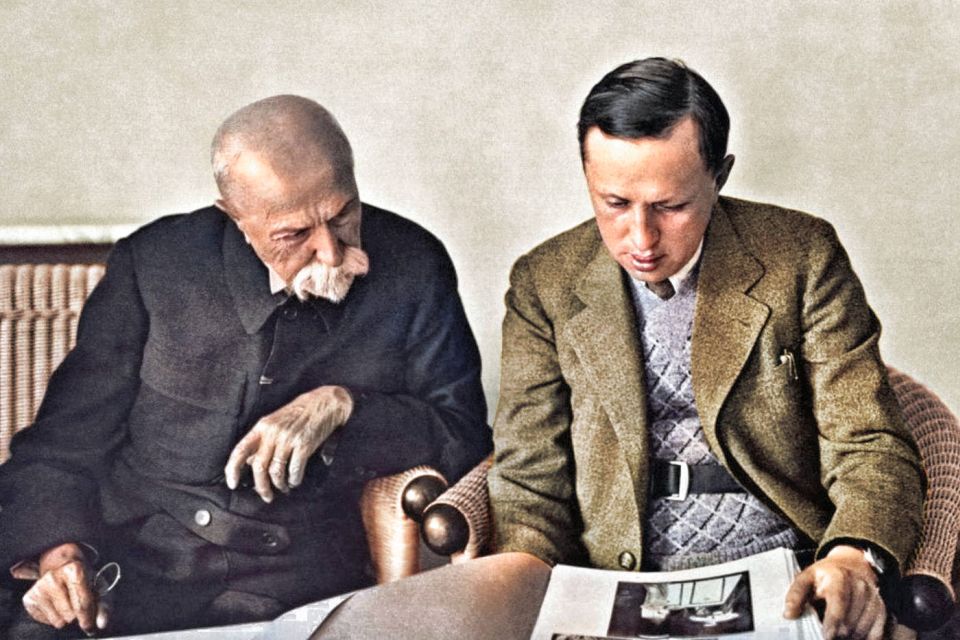
In April 1924, Božena Čapková died, and a year later, the brothers moved from their apartment in Malá Strana to a duplex house in the Vinohrady district of Prague. Karel lived with his widowed father in one half, while the other half was occupied by his brother Josef and his family, who had set up a painting studio in the attic. From that time on, the legendary "Friday Gatherings," a debating club of prominent figures in political and cultural life, regularly took place at Karel's house. Frequent visitors to these Friday gatherings included President T.G. Masaryk, Edvard Beneš, Ferdinand Peroutka, František Langer, Karel Steinbach, Eduard Bass, Karel Poláček, Václav Rabas, Jan Masaryk, and Vilém Mathesius. Karel Čapek published the conversations he had with President Masaryk between 1928 and 1935 as a book titled Conversations with T.G. Masaryk. A total of three volumes were published.
Karel began writing books before World War I, initially in collaboration with his brother Josef, who was primarily a visual artist. Together, they wrote the comedy The Robber, the plays The Insect World, The Good Soldier Švejk, and the one-act play The Fatal Game of Love, and the collection of stories Krakonos's Garden about the places of their youth. Later, he wrote children's books such as Nine Fairy Tales, The Story of a Puppy, and I Had a Dog and a Cat.