
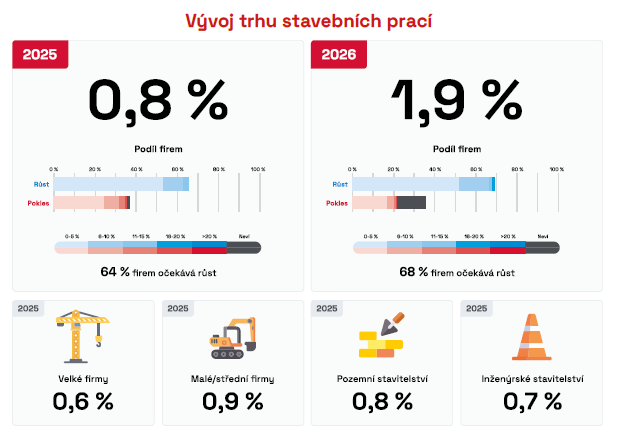
The construction sector in the Czech Republic is expected to experience a slight market growth of 0.8% in 2025, and this positive trend is projected to continue in the following year. The market could grow by an average of 1.9%. Growth is anticipated in both civil engineering projects (0.7% in 2025) and building construction (0.8%). In 2026, both sectors could achieve an average growth rate of 1.9%. This is according to the Quarterly Analysis of the Czech Construction Industry Q4/2024, published by CEEC Research at the "Meeting of Leaders of the Czech Construction Industry" conference held at Prague Castle.
According to the macroeconomic forecast from the Czech Ministry of Finance, GDP is expected to grow by 1.2% in 2024, which could positively impact the construction sector in the coming years. Furthermore, the draft state budget for 2025 includes record investments in transport infrastructure and public projects, which will help ensure a stable demand for construction services. The Ministry of Finance also anticipates a decrease in the average inflation rate to 3.1% in 2024, which could lead to stabilization of construction material prices and costs, thereby encouraging investment in the construction sector.
According to a recent survey by CEEC Research, construction companies in both the building construction and civil engineering sectors have similar prospects for market growth. Companies focused on civil engineering projects expect a 0.7% increase in workload in 2025, while those specializing in building construction anticipate a 0.8% increase. In 2026, both sectors are forecasting further market growth, approximately 1.9%. These positive expectations are not only based on positive macroeconomic forecasts. The government is planning measures to support affordable housing, which is increasing demand for building construction, for example, through programs for the construction of rental apartments and the renovation of existing housing stock. The stabilization of construction material prices after previous increases also makes it easier for companies to plan and implement projects in both of these key sectors.
"The current development of the Czech construction industry shows mixed signals. According to data from the Czech Statistical Office, construction output increased by 2.5% year-on-year in 2023, indicating a slight recovery in the sector. Despite this growth, the construction sector faces several challenges. One of these is the inefficient digitalization of construction permitting, and another factor is the shortage of skilled labor, which limits the capacity of companies and can hinder the implementation of projects. Overall, the Czech construction industry is experiencing a period of moderate growth, but it faces significant challenges that need to be addressed to maintain and strengthen this trend. Key priorities will be improving the digitalization of construction permitting and addressing the shortage of skilled labor," says Michal Vacek, Director of CEEC Research.
"We expect a more significant revival of the construction market in 2025, and consequently, increased demand for building materials. This revival is driven by the gradual stabilization of the market and the 'magic' threshold for mortgage interest rates, which could fall below 4% in the first half of the year. This will significantly impact investor interest in building homes. According to our internal data, the desire for homeownership among investors has not disappeared, but due to the unfavorable domestic economic situation in recent months, they have decided to postpone investments in homeownership and wait for better financing conditions," comments Kamil Jeřábek, CEO and director of Wienerberger, confirming data from a CEEC Research survey.
And Dušan Kunovský, Chairman of the Board of Central Group, also sees a positive outlook for the construction market: "I expect a significant increase, particularly in residential construction. Demand for apartments has increased dramatically this year and is approaching the levels of the record year 2021. Interest in apartments and the willingness of companies to start construction will further increase with further declines in interest rates, although it is likely to be slower than previously anticipated."
Construction companies will also see a positive impact on their revenues.
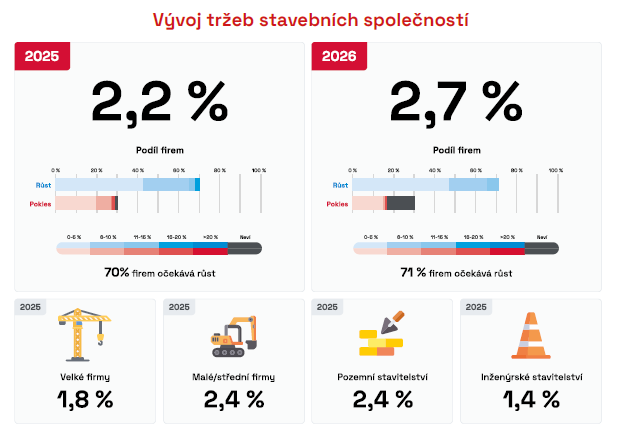
Companies focused on land-based construction projects expect an increase of 2.4% in 2025 and 2.9% in 2026. This is due to easier access to financing, including support from banks and mortgages. Residential and commercial projects therefore have a better foundation for rapid implementation. In addition, land-based construction projects are subject to less complex permitting processes than large infrastructure projects, which speeds up the construction process and return on investment.
Companies specializing in infrastructure projects, such as roads and utilities, are more cautious in their estimates, forecasting growth of 1.4% in 2025 and 2.1% in 2026. They are dependent on government investments and budget constraints, and their implementation is often affected by seasonal conditions.
Jaroslav Heran, CEO of Metrostav, views the situation in the construction market as follows: "If falling interest rates encourage private investors to implement postponed projects, especially in the residential construction segment, and if the pace of investment in transport infrastructure does not slow down, we believe that the Czech construction industry will grow by several percentage points in 2025. This growth should also be supported by planned investments in the energy and heating sectors."
Moritz Freyborn, Chairman of the Board of STRABAG, is also optimistic about the development of the construction market: "I view the level of investment in construction in the Czech Republic as more stable than in other European countries, such as Germany or Austria. I expect a revival in the residential real estate market. Thanks to falling inflation and the gradual reduction in interest rates, investments in residential construction should begin to grow again. However, it is likely that the supply of new apartments will continue to be affected by the rising cost of building materials and labor, as well as the slower start of new projects. It will be very important to improve the building permitting process to support new and affordable housing."
Construction companies are typically contracted for projects an average of **nine months in advance**. For 31% of them, this represents more contracts than in the same period of the previous year, while for 33% of companies, the duration of contracted projects remains the same. Construction company executives report that their capacity utilization is as high as 93%, which is a typical situation for this time of year in the industry. A traditional, slight decrease in workload is expected in the first quarter of 2025, to approximately 85%, due to seasonal factors. The year 2025 should be a year of recovery. Construction company executives anticipate positive changes that could contribute to market stabilization and the growth of the entire industry. The data are based on the **Quarterly Analysis of the Czech Construction Industry, Q4/2024**, prepared by the analytical company CEEC Research, which is published in full on www.ceec.eu. CEEC Research Helena Grofová/ gnews - RoZ