
Welcome back to China Insights Weekly. Here are some of the key takeaways from this edition:
- China aims for 70% localization of chip manufacturing equipment by 2027, with 28nm systems nearing mass adoption.
- Clean energy capacity surpasses fossil fuels, with solar energy growing by 1,500% in a decade.
- Global pharmaceutical giants are closing billion-dollar deals in China, with siRNA and GLP-1 expanding.
- Humanoid robotics are gaining national standards, with 330 models launched in one year.
Top Stories
Panasonic has partnered with the Chinese group Skyworth Group to transfer its sales, marketing, logistics, and manufacturing operations in the TV sector in North America and Europe to Skyworth starting in April 2026. Panasonic will retain ownership of the brand and quality control, focusing on premium models in Japan; Skyworth, the third-largest global manufacturer of OLED TVs, will take over operational management to reduce costs and improve profitability. The agreement includes joint development of premium OLED TVs. The goal is to achieve a double-digit market share in Europe, which is another example of a Japanese electronics giant transferring its TV operations to Chinese manufacturers, following similar moves by Sony, Sharp, and Toshiba.

Frontier Biotechnologies signed an agreement with British pharmaceutical giant GSK on February 16. GSK acquired exclusive global rights to develop and commercialize two siRNA therapies under a deal worth over $1 billion. The financial structure includes an upfront payment of $40 million, $13 million in short-term milestone payments, and up to $950 million in development and commercialization milestones, plus royalty payments. Frontier, based in Nanjing, will continue Phase I studies and file for new drug approval (IND) applications in China for both drugs, one of which is currently in Phase I and the other in the preclinical phase, while GSK will lead subsequent global development and commercialization. The deal provides Frontier with a significant influx of cash and international validation of its siRNA technology platform.
Pfizer has secured exclusive rights to commercialize Sciwind Biosciences' ecnoglutid, a GLP-1 type weight-loss drug, in China, under a deal worth up to $495 million, including an upfront payment and milestone payments tied to regulatory approval and sales. Ecnoglutid received approval for the treatment of type 2 diabetes in January, and its application for approval for long-term weight management is currently under review by Chinese regulators. The deal targets the growing Chinese obesity market, where 14.1% of adults are classified as obese, in a competitive environment that includes five approved GLP-1 drugs, including Novo Nordisk's semaglutide and Eli Lilly's tirzepatide, which triggered a price war at the end of last year, with price reductions of 50% and 80%, respectively. Sciwind has separately licensed rights for markets outside of China to the South Korean company HK Inno.N and the British company Verdiva.
Nike-backed ACG opens its first global store in Beijing amid a boom in Chinese sportswear
The All Conditions Gear (ACG) brand, backed by Nike, has opened its first global branded store in the upscale Beijing district of Sanlitun, operated directly by Nike to capitalize on the growing Chinese outdoor sports market. This follows the entry of Norwegian brand Norrøna, British brand Soar, and Canadian brand Ciele Athletics last year, with Topsports International Holdings serving as the exclusive operating partner for these three brands in China. Topsports has also launched Ektos, a collection of running brands that includes these labels. According to Authentic Brands Group, 70% of its portfolio focuses on outdoor sports. Nike's revenue in China remains roughly one-third of its revenue in North America, and there is significant room for expansion, as consumer demand shifts towards more expensive, specialized equipment, and lower-tier cities offer growth opportunities.

China reportedly ramps up efforts in chip equipment manufacturing, sets 70% target by 2027
China has set a goal to achieve 70% localization of semiconductor manufacturing equipment for advanced, yet established, manufacturing processes by 2027. This is in contrast to current requirements that mandate chip manufacturers to source more than 50% of their equipment from domestic sources when expanding production capacity. This push, driven by US sanctions and concerns about supply chain security, is being spearheaded by domestic champions SMEE, NAURA Technology Group, and AMEC. SMEE has moved its 28nm ArF immersion lithography systems into the validation phase, while NAURA has begun mass production of 28nm etching equipment, and AMEC is validating equipment for the 14nm process. Furthermore, China is reportedly assembling a prototype EUV system using components from older ASML systems, with the aim of achieving functional chip production by 2028. Industry reports suggest that the validation cycles for domestic equipment are taking approximately one year to complete.
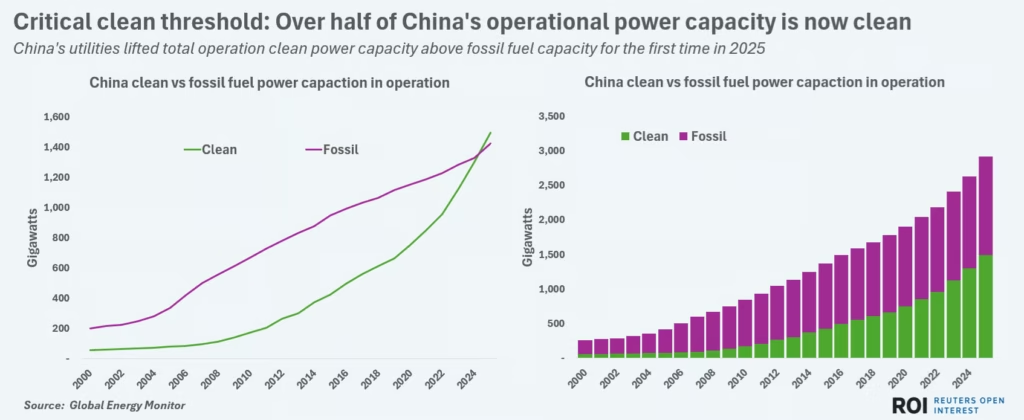
China's Epic Renewable Energy Boom Propels It into a Rare Clean Energy Club
In 2025, China achieved a historic milestone in its energy transformation, installing 1,494 gigawatts of clean energy capacity and, for the first time, surpassing the capacity of fossil fuels (1,420 GW) by 73 GW. Clean energy sources now account for 51% of China's energy mix, placing the country alongside Brazil, France, and Germany as major economies increasingly powered by clean energy. This transformation has been driven by a 1,554% increase in the capacity of large-scale solar power plants since 2015, with their share of operational capacity rising from 2.4% to 18.3%, while the share of coal has fallen from 64% to a record low of 42.7%. The total capacity of clean energy increased by 253% between 2015 and 2025, compared to a 50% increase in the capacity for electricity generation from fossil fuels, leading to an overall increase of 113% in total electricity generation capacity over that decade.
Tomáš Kučera & Yereth Jansen
china-insights.com/gnews.cz – GH